

Most Malaysian SME owners can tell you how busy the warehouse is. Fewer can tell you whether it is getting better. A small set of warehouse KPIs answers that question: how accurate your stock is, how accurate your orders are, how fast you ship, and how healthy your stock levels are.
Quick answer:
The most useful warehouse KPIs for a Malaysian SME are inventory accuracy, order accuracy, order cycle time, stockout rate, inventory turnover and on-time delivery. Track them monthly from stock-take and order data. A warehouse management system such as 8Stock keeps that data in one place, so you can measure instead of guess.
Table of contents
What Are Warehouse KPIs, And Why Do They Matter?
A warehouse KPI (key performance indicator) is a number you track regularly to see how well your warehouse is running. In other words, warehouse performance metrics turn “it feels slow” or “we always seem to run out” into something you can compare month to month.
For a Malaysian SME selling on Shopee, Lazada or WooCommerce, this matters because small errors multiply fast. One wrong-item parcel means a return, a refund and an unhappy buyer. One stock out during a mega-sale means lost orders you cannot get back. Because stock often sits in spreadsheets and orders arrive from several channels, these problems stay hidden until a customer complains.
You do not need a long dashboard. Instead, start with the six below and add more only when you will act on them.
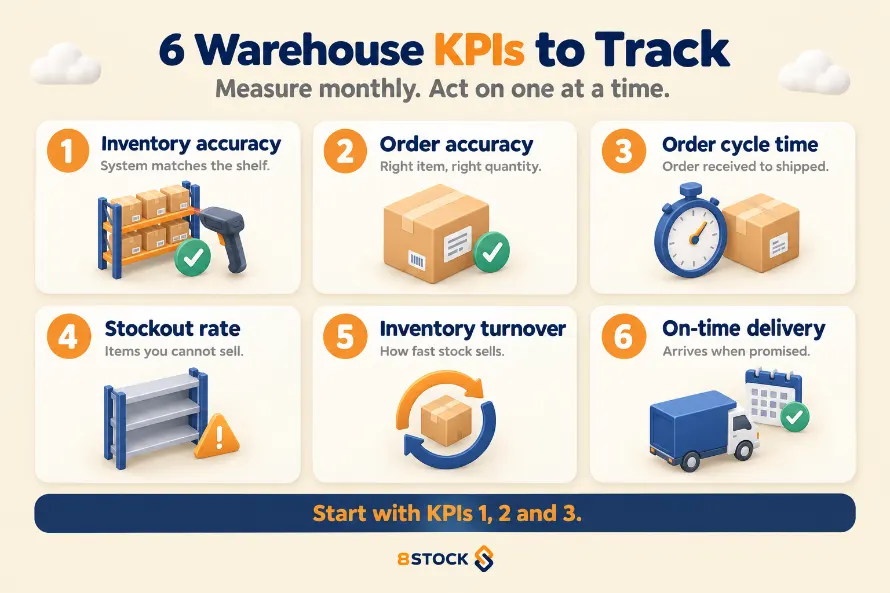
The 6 Warehouse KPIs To Track
1. Inventory accuracy
What it tells you: how closely your system stock matches what is physically on the shelf.
Formula:
Inventory accuracy (%) = (physical count (physical) ÷ items counted (system)) × 100.
Why it matters: every other KPI depends on it. If the system says 50 and the shelf holds 42, you will oversell, and your reorder decisions will be wrong. Illustration only: if you count 200 items and 190 match the system, accuracy is 95%.
Where the data comes from: stock-take counts compared with system quantities. 8Stock’s Report Management module provides stock-take reports that are date-selectable and exportable to Excel, so you can compare counts over time.
2. Order accuracy
What it tells you: how often you ship the right item, in the right quantity, to the right customer.
Formula:
Order accuracy Rate = (orders shipped correctly ÷ total orders shipped) × 100.
Why it matters: For example, wrong-item and short-shipped orders are expensive for sellers: you pay for return handling, you may refund, and you risk poor ratings on the marketplace. Tracking it by week shows whether a busy period is causing mistakes.
Where the data comes from: your order records plus return and complaint logs. Order Management fulfils multi-channel sales orders against real-time inventory, which gives you one set of orders to measure against instead of one per marketplace.
3. Order cycle time
What it tells you: how long it takes from an order arriving to the parcel being shipped.
Formula:
Order cycle time = (delivery date – order date) / total orders shipped
Why it matters: buyers on Shopee and Lazada expect fast dispatch, and slow handling shows up as late shipments and cancellations. If you want to push this number down, see our guide on mastering 4-hour click-to-ship performance.
Where the data comes from: order received and dispatched times from your order and shipping records. Delivery Management handles multi-channel delivery with consignment-note printing and real-time updates from shipping providers.
4. Stockout rate
What it tells you: how often you cannot fill demand because an item is out of stock.
Formula (measured at the same point each week or month):
Stockout rate = (active SKUs out of stock ÷ total active SKUs) × 100
Why it matters: a stock out is a lost sale, and for fast movers it can cost you marketplace visibility too. Watching this KPI before a sale campaign tells you which SKUs to replenish first.
Where the data comes from: live stock levels. Inventory Management keeps stock centralised across the company under one view, which improves visibility and demand planning.
5. Inventory turnover (days of stock)
What it tells you: how quickly stock sells and gets replaced, and how much cash sits idle on shelves.
Formula:
Inventory turnover = cost of goods sold (MYR) ÷ average inventory value
Why it matters: low turnover means money tied up in slow movers; very high turnover can mean you are always close to running out. Compare each product group against its own past results rather than against a generic target.
Where the data comes from: sales figures and stock value for the period. Export your stock reports to Excel from Report Management and calculate it there. For FMCG sellers, batch and expiry control also help you see which stock is ageing.
6. On-time delivery
What it tells you: how many orders reach the customer by the date you promised.
Formula:
On-time delivery rate = (orders delivered on time÷ total number of deliveries) × 100.
Why it matters: late delivery is the most visible failure to your customer, even when the cause is a courier delay. Tracking it by courier (for example GDEX, Pos Laju or DHL eCommerce) shows whether a shipping partner needs review.
Where the data comes from: shipping status updates against promised dates. Delivery Management brings in real-time updates from shipping providers and marketplaces so you do not have to chase each courier site separately.
Summary: the 6 KPIs at a glance
| # | KPI | Question it answers | Formula | Where the data lives |
|---|---|---|---|---|
| 1 | Inventory accuracy | Does the system match the shelf? | Matching items ÷ items counted | Stock-take reports (Report Management) |
| 2 | Order accuracy | Do we ship the right thing? | Correct orders ÷ orders shipped | Order records (Order Management) |
| 3 | Order cycle time | How fast do we ship? | Avg (shipped − received) | Order and shipping records (Order + Delivery Management) |
| 4 | Stockout rate | Are we missing sales? | SKUs out of stock ÷ active SKUs | Live stock view (Inventory Management) |
| 5 | Inventory turnover | Is cash stuck in slow stock? | COGS ÷ average inventory value | Stock reports exported to Excel |
| 6 | On-time delivery | Do customers get parcels when promised? | On-time orders ÷ delivered orders | Shipping updates (Delivery Management) |
How to start tracking warehouse KPIs without a big project
- Pick three first. Most SMEs get the quickest value from inventory accuracy, order accuracy and order cycle time.
- Set a monthly review. Same day each month, same person, same definitions. Consistent measurement matters more than perfect measurement.
- Compare against yourself. Use your own last three months as the baseline. This post deliberately gives no “good” targets, because the right level depends on your products, channels and team.
- Export and chart in Excel. Use date-selectable stock reports and keep a simple sheet of month-by-month results.
- Act on one number at a time. If inventory accuracy is slipping, fix counting discipline before you chase the other five.
If you are wondering what technology can add on top of this, our article on the role of technology in modern warehouse management covers the wider picture.
How 8Stock helps you track warehouse performance
8Stock is a cloud-based warehouse and inventory management system by Uniqbe Digital Sdn Bhd in Kuala Lumpur, built for Malaysian businesses. For KPI tracking, the useful parts are:
- Inventory Management: centralised stock under one view, with item-level tracking (serial, batch, quantity, barcode) for cleaner counts.
- Order Management: multi-channel orders with real-time inventory, connected to Shopee, Lazada, WooCommerce and nopCommerce.
- Delivery Management: real-time updates from shipping providers and marketplaces, plus consignment-note printing.
- Report Management: daily, monthly, quarterly and yearly stock-take reports, date-selectable and exportable to Excel.
- Real-time dashboard: designed so you do not need technical expertise to read it, and accessible anywhere because it is cloud-based.
Together these put the data behind your KPIs in one system instead of several spreadsheets. See how this fits into a full setup in our guide to the best warehouse management system in Malaysia, or explore 8Stock warehouse management solutions.
Request a Demo · WhatsApp +60 12 381 1376
Frequently asked questions
What are the most important warehouse KPIs for a small business?
Start with inventory accuracy, order accuracy and order cycle time. They show whether your stock is reliable, whether you ship the right items, and how fast you dispatch. Add stock out rate, inventory turnover and on-time delivery once the first three are tracked consistently each month.
How often should an SME review warehouse KPIs?
Monthly is a practical starting point for most SMEs, with a quick weekly check on stock out rate and order cycle time during busy periods such as Shopee or Lazada mega-sales. Use the same definitions every time so month-to-month comparisons stay meaningful.
Do I need a WMS to track warehouse KPIs?
No, you can start with spreadsheets. The problem is accuracy and effort: counts, orders and shipping updates live in different places and drift apart. A warehouse management system like 8Stock keeps stock, orders, delivery updates and reports in one place, which makes KPIs easier to calculate reliably.
Can I export 8Stock stock reports to Excel?
Yes. 8Stock’s Report Management module provides daily, monthly, quarterly and yearly stock-take reports that are date-selectable and exportable to Excel. You can use these exports to calculate KPIs such as inventory accuracy and inventory turnover in your own spreadsheet.
Ready to measure your warehouse properly?
Book a free 8Stock demo and see how stock, orders, delivery and reports work together for a Malaysian SME.