
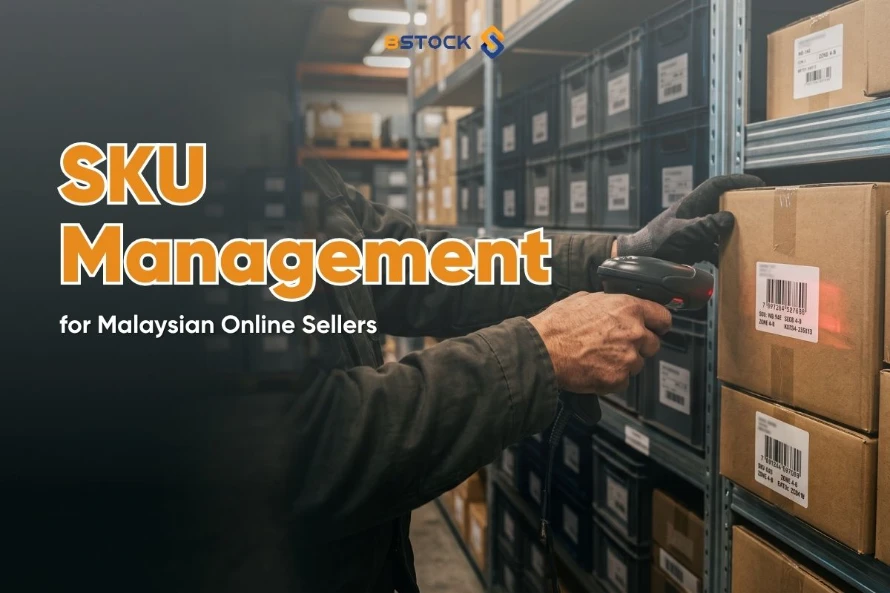
If the same product has three different codes — one on Shopee, one on Lazada, one on the storeroom shelf — your stock numbers are already drifting apart. That mismatch is where overselling, wrong picks, and angry marketplace buyers start. Here’s how Malaysian multi-channel sellers fix it for good.
Quick answer:
SKU management means giving every product variant one consistent code across every channel and location. For Malaysian multi-channel sellers, poor SKU management is the hidden cause of overselling and pick errors — a centralised system with multi-UOM and barcode support keeps Shopee, Lazada and WooCommerce SKUs in sync automatically.
Table of contents
What Is SKU Management (and Where Multi-Channel Sellers Get It Wrong)
A SKU (Stock Keeping Unit) is the unique code your business assigns to a specific product variant — size, colour, packaging, whatever makes it distinct. SKU management is the discipline of keeping that code consistent everywhere it’s used: your storeroom, your invoices, and every marketplace you sell on.

It’s a different job from a UPC/barcode (the manufacturer’s universal code printed on the product) and from a UOM (unit of measure — the same SKU might be sold as a single piece on Shopee and a box of 12 to a wholesale buyer). Multi-channel sellers usually get into trouble not because they lack SKUs, but because each marketplace ends up with its own version of the same one — created at different times, by different staff, with no shared source of truth.
Why SKU Management Matters
Clean SKU data isn’t admin busywork — it’s what your stock count, your pick list, and your marketplace listings all rely on to agree with each other. When SKUs are consistent, a sale on any channel updates one real number instead of three guesses. That means fewer stockouts, faster pick-and-pack, and marketplace rankings that don’t get punished for cancelled orders.
What Happens When SKU Management Goes Wrong?
Mismatched SKUs mean your system shows stock that isn’t really there, or misses stock that is. Staff pick the wrong item, marketplaces get sold out of items you still have, and reconciling the difference eats hours every week that should have gone into growing the business.
5 SKU Mistakes Malaysian Multi-Channel Sellers Make
- Different SKUs per channel — the same product gets a fresh code every time it’s listed on a new marketplace, instead of reusing one master SKU.
- Inconsistent naming conventions — no standard format (product type, variant, size), so staff can’t tell items apart at a glance.
- No barcode standard — items get picked and packed by eye instead of by scan, which is slower and more error-prone.
- Manual UOM conversion errors — converting “1 box = 12 pieces” by hand across spreadsheets, with no system enforcing the math.
- No single source of truth — stock is tracked separately per marketplace dashboard, so nothing updates in real time when a sale happens elsewhere.
Why Do SKU Problems Spike During Shopee and Lazada Mega-Sales?
Mega-sale campaigns compress days of normal order volume into hours. Any SKU mismatch that was a minor annoyance on a normal Tuesday becomes a same-hour stockout during a flash sale, because there’s no time for a staff member to manually catch and correct the error before the next order comes in.
What Does a Phantom Stockout Actually Cost You?
A phantom stockout — where the system says “in stock” but the shelf is empty — costs more than one lost sale. It usually means a cancelled order, a dent in your Shopee/Lazada seller rating, and a refund to process, on top of the original sale you never got to make.
An Example Scenario: SKU Chaos at a Malaysian SME
Picture a home-and-living seller in the Klang Valley selling the same ceramic mug on Shopee, Lazada, and their own WooCommerce store. Over time, each channel ended up with its own SKU for the same mug — one created when the Shopee store launched, another when Lazada was added a year later, a third from an old spreadsheet nobody retired. Each channel’s “stock available” number was really just a guess based on the last manual count.
During a marketplace mega-sale, all three channels sold the item simultaneously. The combined orders exceeded actual stock within the first hour — but because the SKUs weren’t linked, nothing flagged it until staff physically ran out of mugs to pack. Several orders had to be cancelled and refunded, and the Shopee listing took a performance hit from the cancellations.
What Would Have Prevented the Stockout?
One master SKU per product, shared across every channel, with real-time inventory that updates the moment any channel sells a unit. If Shopee, Lazada and WooCommerce were all drawing from the same live number, the second and third channel would have shown “sold out” the instant the first channel sold the last unit — no oversell, no refund, no ranking penalty.
How 8Stock Helps
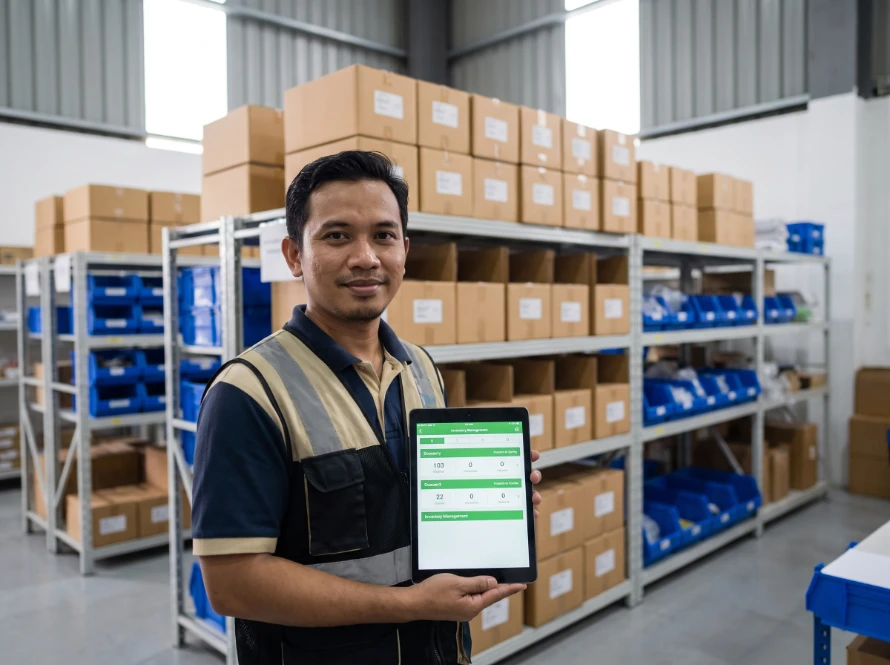
8Stock’s Inventory Management module keeps stock for the whole business under one centralised view, so every channel is reading from the same real number instead of a separate guess. On top of that, 8Stock supports item-level tracking — SKU, barcode, and multi-UOM management — so a product sold as a single piece on Shopee and a case of 12 to a wholesale buyer stays accurate under one master SKU. Combined with 8Stock’s marketplace integration (Shopee, Lazada, WooCommerce, nopCommerce), a sale on any channel updates your real stock count everywhere else, automatically.
For a Malaysian multi-channel seller, that’s the difference between finding out about a stockout from an angry buyer, and never having one in the first place.
Request a Demo → or WhatsApp +60 12 381 1376 to see how 8Stock’s inventory and SKU tools work for your product range.
FAQ
What is SKU management in a warehouse system? SKU management is the process of assigning and maintaining one consistent product code across your entire business — storeroom, invoices, and every sales channel. In a warehouse system, it’s what links a physical item on the shelf to a single, accurate stock count, instead of separate numbers per location or platform.
How do I stop duplicate SKUs across Shopee and Lazada? Consolidate every channel listing under one master SKU inside a centralised inventory system, rather than letting each marketplace generate its own code. When Shopee, Lazada and WooCommerce all read from the same live stock number, duplicate or conflicting SKUs stop being possible.
Does 8Stock support multi-UOM and barcode SKUs? Yes. 8Stock supports item-level tracking including SKU, barcode, and multi-UOM management, so the same product can be sold as a single unit on one channel and in bulk quantities to another buyer — all tied back to one accurate stock record.
Is SKU management different from inventory management? SKU management is one part of inventory management. SKU management focuses on how products are identified and coded; inventory management is the broader discipline of tracking how much of each SKU you have, where it is, and when it needs replenishing.
Request a Demo · WhatsApp +60 12 381 1376
Related reading: Mastering SKU Management: A Handy Guide for Users Learn more: 8Stock Inventory Management · Warehouse Management Solutions