
Inventory carrying cost is the yearly price of keeping unsold stock: the cash it ties up, the space it takes, the insurance and admin it needs, and the stock you lose to expiry or damage. For most Malaysian SMEs it never shows up as one line in the accounts, so nobody manages it.
After 11.11, with leftover stock on your shelves, you can put a number on it.
Quick answer
Inventory carrying cost is what you pay each year to hold unsold stock: capital tied up, storage, insurance and admin, plus losses from expiry or damage. Add the costs, divide by your average inventory value, then multiply by 100 to get a percentage.
Table of contents:
What Is Inventory Carrying Cost?
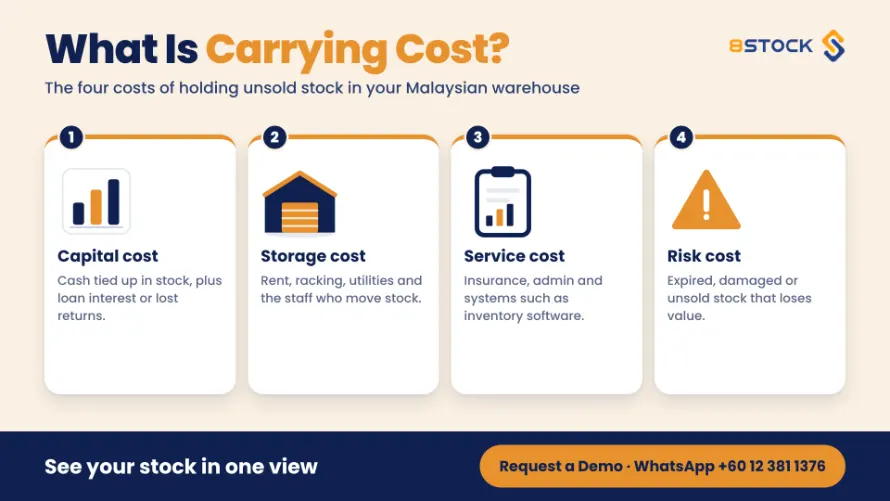
Inventory carrying cost, also called holding cost, is the total yearly expense of storing and keeping stock until you sell it. Finance and inventory guides from Zoho, QuickBooks and NetSuite split it into four parts.
| Component | What it covers | Malaysian SME example |
|---|---|---|
| Capital cost | Cash tied up in stock, plus loan interest or the return that cash could earn elsewhere | An October supplier invoice for 11.11 stock that is still unsold in December |
| Storage cost | The space and the work to run it | Warehouse or shophouse rent in the Klang Valley, racking, utilities, staff who count and move stock |
| Service cost | Insurance, admin and systems | Stock insurance, accounting and inventory software subscriptions |
| Risk cost | Stock that loses value while it waits | Expired FMCG items, damaged boxes, shrinkage, products nobody wants once a campaign ends |
How to Calculate Inventory Carrying Cost
Use this formula:
Carrying cost % = (annual carrying costs ÷ average inventory value) × 100
Find average inventory value by adding your opening and closing stock value for the year and halving the total. Here is an example with made-up numbers.
| Item | Yearly amount (illustrative) |
|---|---|
| Average inventory value | RM 180,000 |
| Capital cost (financing and tied-up cash) | RM 12,000 |
| Storage cost (RM 1,600 rent a month × 12) | RM 19,200 |
| Service cost (insurance, software) | RM 3,600 |
| Risk cost (expired and damaged write-offs) | RM 6,600 |
| Total carrying cost | RM 41,400 |
| Carrying cost % | 23.0% |
Now price your slow stock. If RM 30,000 of that inventory has not moved in months, it costs about RM 6,900 a year to keep (RM 30,000 × 23.0%). That cash buys nothing until the stock sells.
These figures are examples. Replace them with your own rent, financing and write-off numbers. The 23.0% is the result of this example, not a Malaysian average.
Where Malaysian SMEs Lose Money Holding Stock
Five patterns show up in many small warehouses and online shops:
- Ordering for a mega-sale on gut feel. Whatever 11.11, 12.12 or Chinese New Year does not sell stays on the shelf and keeps costing you.
- Short-dated stock. FMCG items near expiry have days left to sell. After that, the cost turns into a write-off.
- Stock in several places. With no single count across a warehouse, a shop and a seller’s home, you reorder an item that sits idle in another location.
- Spreadsheet counts. A spreadsheet shows totals. It does not show which items have stopped selling.
- Padding marketplace stock. When you cannot trust the number, you hold extra on Shopee and Lazada “just in case”.
See your stock in one view. Request a Demo → or WhatsApp the team at +60 12 381 1376.
5 Ways to Reduce Inventory Carrying Cost
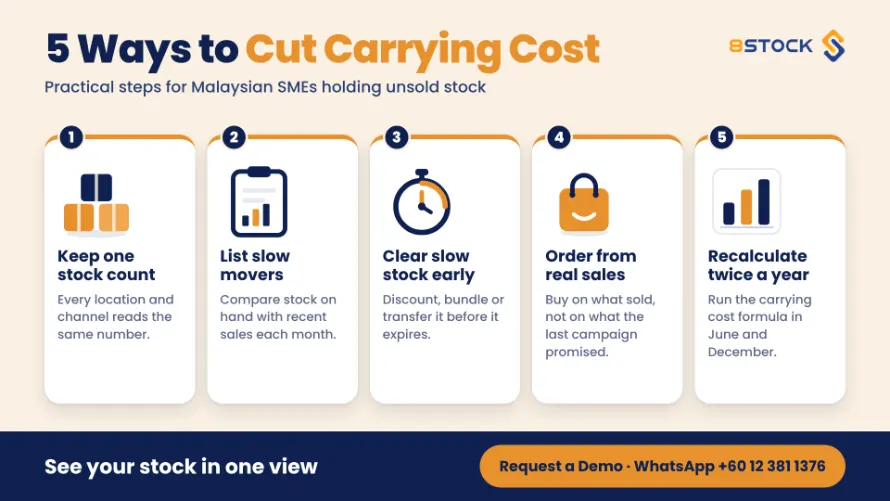
- Keep one stock count. Every location and sales channel should read from the same number.
- List your slowest movers every month. Compare stock on hand with recent sales and write down the items that have stopped moving.
- Clear slow stock early. Discount, bundle or transfer it to a location where it sells before it expires or goes out of season.
- Order from real sales. Base the next purchase on what sold, not on what the last campaign promised.
- Recalculate twice a year. Run the formula above in June and December and watch the percentage move.
For expiry-driven stock, read our guide to FIFO vs FEFO in Malaysia. For the wider trade-offs of holding stock, see the pros and cons of inventory management.
How 8Stock Helps You Control Carrying Cost
8Stock is a cloud-based warehouse and inventory management system Malaysia SMEs can run from Uniqbe Digital in Kuala Lumpur. These modules support the five steps above:
- Inventory Management puts stock across the whole business in one view, which improves visibility and demand planning.
- Warehouse Management tracks stock across multiple locations and handles stock transfers, so you can move idle stock to where it sells.
- Order Management fulfils multi-channel sales orders with real-time inventory tracking, including Shopee, Lazada, WooCommerce and nopCommerce orders.
- Report Management produces daily, monthly, quarterly and yearly stock-take reports, selectable by date and exportable to Excel, so you can pull quantities into the carrying cost formula.
- Item-level tracking records batch, serial, quantity and barcode, so you know what you hold.
Want the full picture? See how 8Stock warehouse management solutions fit a growing SME, or read why teams rate it the best warehouse management system in Malaysia.
See your stock in one view. Request a Demo → or WhatsApp the team at +60 12 381 1376.
FAQ
What is inventory carrying cost? Inventory carrying cost is the total yearly cost of holding unsold stock. It adds the capital tied up in stock, storage, insurance and admin, and losses from expiry, damage or theft. Businesses express it as a percentage of average inventory value, which makes it easy to compare from year to year.
How do I calculate inventory carrying cost? Add your yearly capital, storage, service and risk costs. Divide the total by your average inventory value, which is opening plus closing stock value divided by two. Multiply by 100. Use your own rent, financing and write-off figures, because the result changes with every business.
Is holding cost the same as carrying cost? Yes. Holding cost and carrying cost mean the same thing: the expense of storing and keeping unsold stock for a period. Some finance teams prefer carrying cost because it stresses the cash tied up in stock. The formula and the four components stay identical.
How can an inventory management system reduce carrying cost? A system cannot cut your rent, but it shows what you hold, where it sits and what has stopped selling. With that view you can transfer, discount or stop reordering slow items sooner. 8Stock gives Malaysian SMEs one stock view across locations and channels, plus stock-take reports exportable to Excel.
Ready to see what your stock costs?
Request a Demo · WhatsApp +60 12 381 1376 · enquiries@8stock.co
Also worth reading: The Pros and Cons of Inventory Management · FIFO vs FEFO in Malaysia