
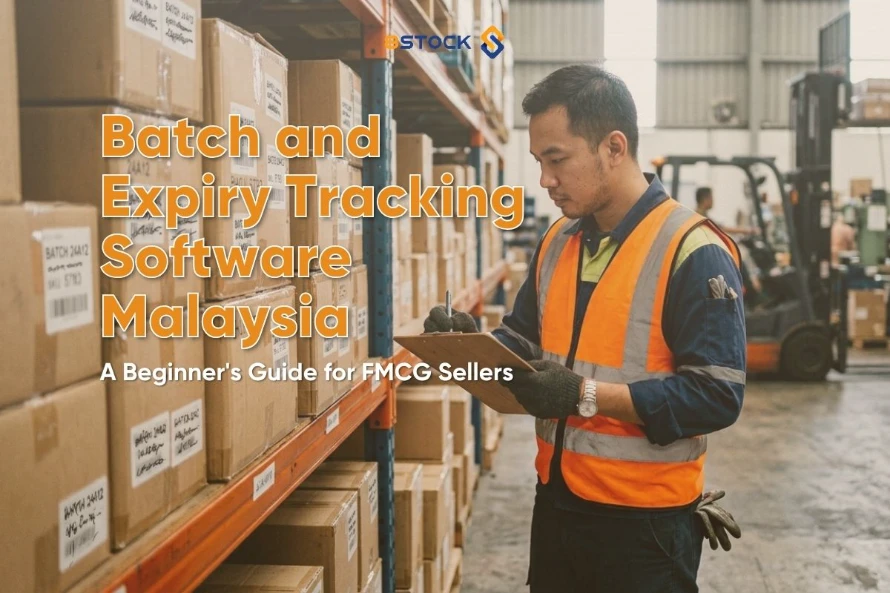
Running an FMCG or wholesale business in Malaysia means one wrong batch shipped past its expiry date can cost you a customer, a return, or worse — a compliance complaint. Batch and expiry tracking software records exactly which batch and expiry date every unit of stock belongs to, then automatically tells your team which units to pick and ship first — so nothing expires quietly on a shelf or gets sold by accident.
Most Malaysian FMCG sellers still track batches and expiry dates on spreadsheets or handwritten stock cards. This works until volume grows — then errors creep in, expired stock gets missed, and stock counts stop matching reality. Dedicated batch and expiry tracking, using FEFO (first-expiry-first-out) logic inside a real-time inventory system, closes that gap by flagging what’s expiring soonest and stopping it from being buried behind newer stock.
Why batch and expiry tracking matters for Malaysian FMCG and wholesale sellers
If you distribute food, beverages, cosmetics, pharmaceuticals, or any perishable or dated product, expiry accuracy isn’t optional — it affects customer trust, returns, and in regulated categories, compliance.
Four problems show up again and again for growing Malaysian FMCG and wholesale operations:
- No visibility into which batch is closest to expiry. Without a system flagging it, older stock sits behind newer deliveries and gets missed.
- Manual stock cards or spreadsheets don’t scale. They work for one warehouse and a handful of SKUs — not for multiple locations, suppliers, and hundreds of batch numbers.
- Picking by memory instead of by rule. Warehouse staff naturally grab the easiest-to-reach box, not the one expiring soonest, unless the system enforces FEFO/FIFO order.
- No single source of truth across locations. If stock and batch data live in different spreadsheets per outlet or warehouse, nobody has a real company-wide picture of what’s about to expire.
The real cost of poor batch and expiry control
| Consequence | What it actually costs you |
|---|---|
| Expired stock sold or shipped | Refunds, customer complaints, damaged trust |
| Written-off inventory | Direct loss on unsold, expired stock |
| Manual audit time | Hours spent physically checking dates before every shipment |
| Compliance risk | Issues with buyers, marketplaces, or regulators in food/pharma categories |
| Poor supplier negotiation | Inaccurate stock data makes it harder to plan reorders around real shelf life |
How to get batch and expiry tracking under control
The fix isn’t more manual checking — it’s putting your stock into a system that tracks batch and expiry data automatically and enforces FEFO/FIFO picking rules.
8Stock supports this through two of its core modules:
- Inventory Management — centralises stock across your whole company in one view, including item-level tracking by batch, quantity, and barcode, so every batch’s location and expiry is visible in real time rather than scattered across spreadsheets.
- Warehouse Management — manages multi-location stock and transfers, so batch and expiry data stays accurate as stock moves between warehouses or outlets, not just within a single site.
For a Malaysian wholesaler running multiple storage locations, this means staff are guided to pick the batch expiring soonest by default, stock counts reflect what’s actually on the shelf, and reporting shows exactly what’s approaching expiry before it becomes a write-off.
See how 8Stock’s real-time inventory management handles batch tracking, or request a demo to see it applied to your own warehouse.
FAQ
Do I need special software to track expiry dates, or is a spreadsheet enough? A spreadsheet can work for a single small warehouse with few SKUs, but it doesn’t scale. As batch counts, locations, and staff grow, manual tracking becomes error-prone and hard to audit. A dedicated inventory system with batch-level tracking removes that risk as you grow.
What is FEFO and why does it matter for FMCG sellers? FEFO (first-expiry-first-out) is a picking rule that ensures stock closest to its expiry date is sold or shipped first. It’s the standard approach for perishable, food, beverage, and pharmaceutical inventory, and it’s most effective when enforced automatically by your inventory system rather than left to staff judgement.
Can 8Stock track batch numbers across multiple warehouse locations? Yes. 8Stock’s Warehouse Management and Inventory Management modules track stock — including batch and item-level detail — across multiple locations under one centralised view, so you see expiry status company-wide, not per site.
Is batch and expiry tracking only relevant for food and pharma businesses? No. Any Malaysian business selling dated or perishable goods — cosmetics, supplements, beverages, packaged food, some FMCG categories — benefits from batch-level visibility to avoid write-offs and maintain customer trust.
Ready to stop tracking expiry dates by hand? Request a free 8Stock demo or WhatsApp us at +60 12 381 1376.
See also: