
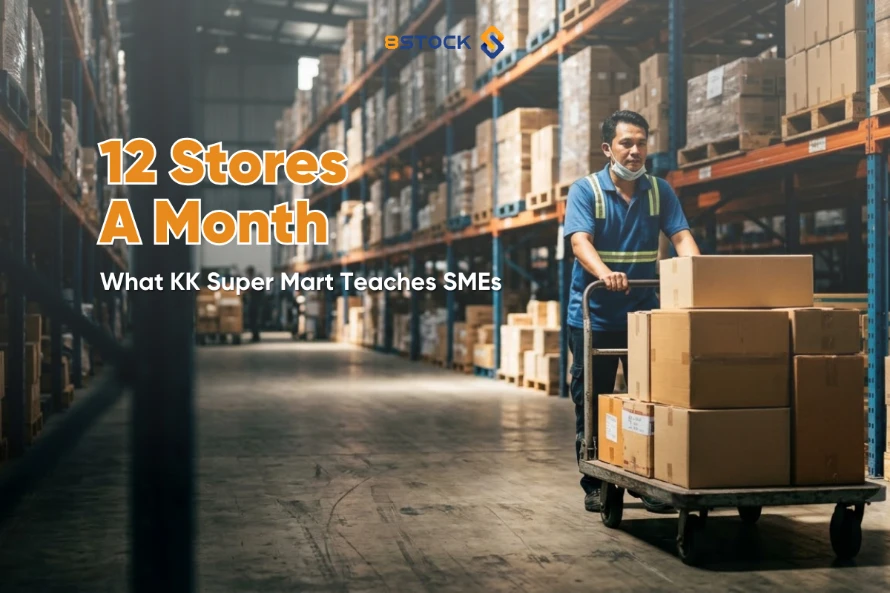
In 2001, Datuk Seri Dr. Chai Kee Kan opened a single convenience store in a Kuchai Lama shop lot with RM60,000 in capital. Today, KK Super Mart operates more than 900 outlets across Malaysia and beyond, opening at a pace of roughly 12 new stores a month — making it the country’s second-largest convenience store chain after 99 Speedmart.
That kind of growth doesn’t happen without serious operational discipline behind the scenes — you simply can’t open a new outlet every few days if your stock numbers are still living in someone’s head or a branch-specific spreadsheet. Here’s what it likely takes to run stock at that scale, and how a much smaller Malaysian seller can borrow the same principles without needing hundreds of outlets to justify it.
What KK Super Mart Teaches SMEs?
Chains that scale to hundreds of outlets — like KK Super Mart, which grew from one Kuala Lumpur shop to 900+ stores — rely on standardised stock control: real-time visibility across every location, consistent reorder rules, and centralised reporting. A growing Malaysian SME can build the same discipline at a fraction of the scale.
KK Super Mart’s Growth, By the Numbers
- 2001 — Founded by Datuk Seri Dr. Chai Kee Kan with RM60,000 in starting capital; first outlet opened in Kuchai Lama, Kuala Lumpur.
- 900+ outlets — Operating nationwide today, per the company’s own store locator, with recent updates citing over 1,000.
- ~12 new stores a month — An expansion pace few Malaysian retailers match.
- ~9,000 products per store — Including its own KK house brand, alongside daily essentials and bill-payment, photocopying and Touch ‘n Go reload services.
- #2 in Malaysia — The country’s second-largest convenience store chain, behind 99 Speedmart (founded 1987).
- Franchise-driven growth — Expansion partly powered by a franchise model, plus moves into international markets including Nepal and India, and a partnership with South Korea’s GS25.
The Operational Discipline Behind Opening 12 Stores a Month
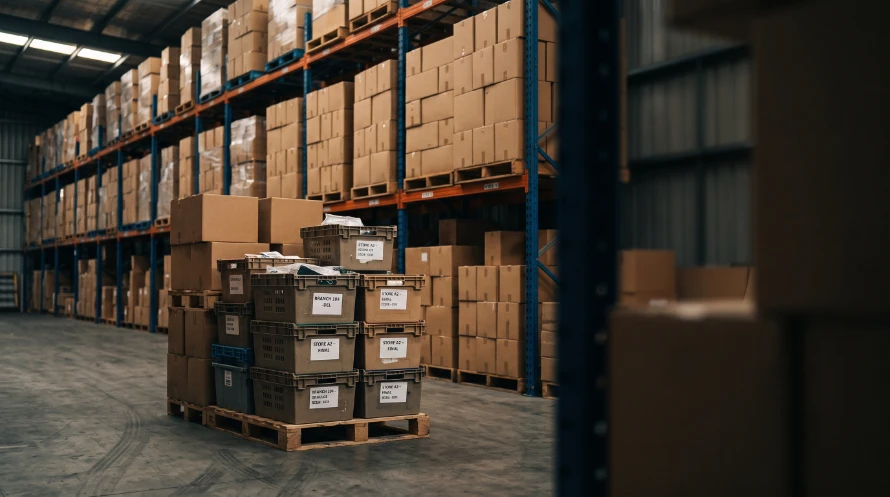
KK Super Mart hasn’t published the specifics of its internal inventory or warehouse systems, so this isn’t a claim about exactly what runs behind the scenes. But retail chains that scale this fast, this consistently, tend to share the same operational traits — because it’s simply not possible to open a new store every two to three days without them.
Centralized stock visibility across locations
With 900+ outlets, there’s no room for a manager phoning around to check which branch has stock. Multi-location chains need one system showing what’s where, in real time, across every outlet.
Standardized SKU and reorder rules
Carrying roughly 9,000 SKUs consistently across hundreds of stores means every outlet works from the same product catalogue and reorder thresholds — not ad hoc decisions per branch.
Franchise-ready, repeatable systems
A franchise model only scales if a new outlet can plug into the same processes on day one. That means the stock system has to be simple enough for a new franchisee’s staff to use without months of training.
What This Means If You’re a Smaller Seller
You don’t need 900 outlets to benefit from this kind of discipline. The same three principles apply the moment you’re running more than one storage location — or even a single warehouse feeding multiple marketplaces like Shopee and Lazada. Malaysian sellers who struggle with stockouts and mismatched stock counts are usually missing exactly what large chains build first: one real-time view of stock, consistent rules for reordering, and a system simple enough for staff to actually use.
Picture a Klang Valley seller running one small warehouse plus a handful of Shopee and Lazada storefronts. Without centralised visibility, staff are checking three different dashboards to answer “do we still have this in stock?” — the exact problem KK Super Mart would face at 900 outlets if every branch kept its own paper count. Scale down the principle, not the discipline: one stock number, one set of reorder rules, one system everyone actually uses.
How 8Stock Brings the Same Discipline to Growing SMEs
8Stock gives smaller Malaysian businesses the same operational backbone, without needing 900 stores to justify it:
- Warehouse Management — multi-location stock tracking and stock transfers between locations, so you always know what’s where.
- Inventory Management — centralises stock across your whole business in one view, instead of one spreadsheet per branch.
- Order Management — fulfils multi-channel sales orders (Shopee, Lazada, WooCommerce, nopCommerce) with real-time inventory tracking, so every channel draws from the same live stock count.
- Report Management — daily, monthly, quarterly and yearly stock-take reports, exportable to Excel, so reordering decisions are based on real numbers, not guesswork.
Running a cloud-based system also means a new staff member or a new location can be onboarded quickly — the same “plug in and go” principle that lets a franchise scale fast.
See what the same discipline looks like for your business. Request a Demo → or WhatsApp the team directly at +60 12 381 1376.
FAQ
How many outlets does KK Super Mart have? KK Super Mart operates more than 900 outlets across Malaysia, according to its own store locator, making it the country’s second-largest convenience store chain behind 99 Speedmart. The company has also expanded internationally, with stores in markets including Nepal and India.
How did KK Super Mart grow so fast? KK Super Mart was founded in 2001 with RM60,000 in starting capital and has grown to 900+ outlets partly through a franchise model, which lets new operators open stores using the same systems and processes rather than building each one from scratch.
Can a small Malaysian business use the same warehouse discipline as KK Super Mart? Yes. The same principles — real-time stock visibility, consistent reorder rules, and systems simple enough for staff to use immediately — apply whether you’re running 900 outlets or a single warehouse feeding Shopee and Lazada. A cloud-based system like 8Stock brings that discipline to a much smaller scale.
What is 8Stock? 8Stock is a cloud-based warehouse and inventory management system built for Malaysian SMEs, with modules for warehouse, inventory, order, delivery and report management, plus integrations for Shopee, Lazada, WooCommerce, nopCommerce, AutoCount and GDEX.
Ready to build the same stock discipline into your business?
Request a Demo · WhatsApp +60 12 381 1376 · enquiries@8stock.co
Also worth reading: 99 Speedmart SWOT Analysis — Secrets Behind the Giant Retail Store